
Kansas City Planning Guide
Kansas City Estate Planning Guide: Missouri vs. Kansas Legal Differences
Estate planning and elder law in bi-state Kansas City. Navigate two legal systems, one city.
Why Kansas City is Different
Kansas City is one of a handful of major American metros split down the middle by a state line. Roughly 2.2 million people live in the metro, and the line between Missouri and Kansas runs literally down the middle of a city street (State Line Road). The practical result:
- Families routinely live in one state and work, worship, bank, or receive medical care in the other.
- People move across the line constantly. A couple raises kids in Brookside (MO), downsizes to Leawood or Overland Park (KS), and never thinks of it as "moving to another state."
- Adult children live in Olathe while Mom is in a Waldo bungalow, or vice versa.
- It is common to own a home in one state and a rental, lake property, or farm ground in the other.
- Hospitals, rehab facilities, and nursing homes sit on both sides, and a discharge planner's recommendation can quietly change which state's Medicaid program governs a family's future.
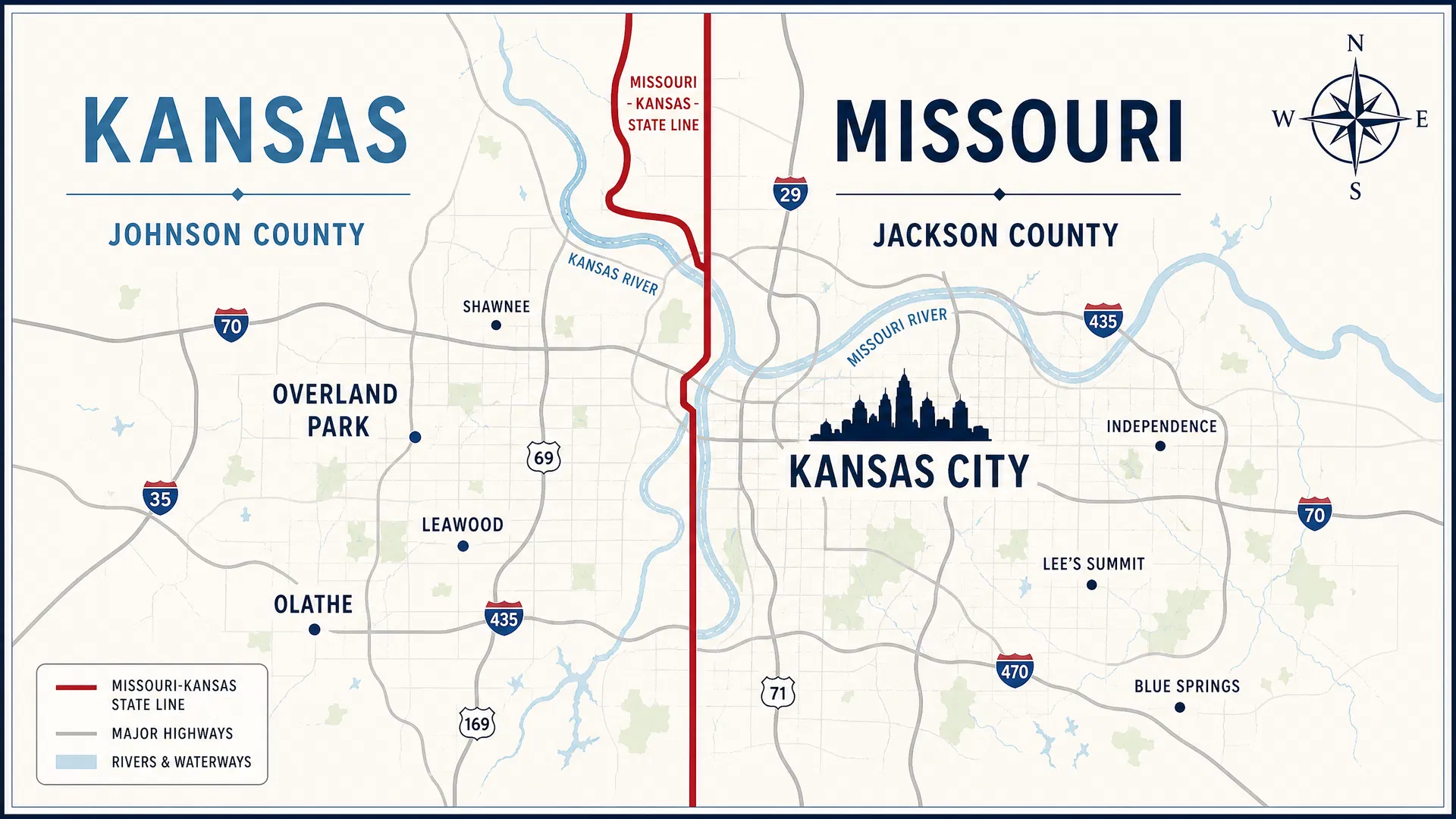
The state line runs through the heart of Kansas City, creating unique legal planning challenges for families on both sides.
The Threshold Question: Which State's Law Applies?
Two rules drive everything:
Rule 1: Domicile at Death
Domicile at death governs probate of personal property, will validity procedures, and the general administration of the estate. Domicile is where you actually live with intent to remain, not where your mail goes.
Rule 2: Situs of Real Estate
Real property is governed by the state where it sits. Land in Kansas is governed by Kansas law no matter where the owner lived, and the same for Missouri land.
The immediate consequence: A Missouri resident who owns a Kansas lake cabin or rental duplex faces ancillary probate in Kansas at death, a second probate proceeding in a second state, unless the property has been moved into a revocable living trust or covered by a transfer-on-death deed. In a metro where cross-line property ownership is routine, this alone makes trusts more valuable here than in a single-state market.
Probate Differences That Matter
Both states require probate for assets titled solely in the decedent's name without beneficiary designations, but the systems feel different in practice.
Missouri
- Reputation for slower, more expensive probate
- Minimum attorney fee schedule as percentage of estate
- Full administration generally runs minimum 6+ months
- Will must be presented within one year of death
- Useful small estate procedures available
Kansas
- Shorter timeline and more streamlined process
- Will must be admitted within six months of death
- Miss the deadline and it can be barred (with limited exceptions)
- Families who "get around to it later" can accidentally disinherit themselves
- Simplified administration procedures available
Nonprobate Transfer Tools: Missouri's Specialty
Missouri essentially invented the beneficiary deed (dating to 1989) and has one of the most developed nonprobate transfer statutes in the country. Kansas followed with its own transfer-on-death deed statute. Both states allow TOD/POD designations on accounts, vehicles, and real estate.
Medicaid and Long-Term Care: The Big Divide
Both states operate under the same federal framework: a 60-month lookback on gifts, spousal impoverishment protections, a home equity cap (currently $752,000), and mandatory estate recovery for long-term care benefits paid after age 55. But the state-level differences are dramatic. For comprehensive planning, see our Medicaid planning guide.
Estate Recovery Scope (The Headline Difference)
Missouri: Probate-Only Recovery
MO HealthNet can only recover from the probate estate. Anything passing outside probate (beneficiary deed, TOD/POD accounts, joint tenancy, trust assets) escapes recovery entirely. This makes the beneficiary deed the workhorse home-protection tool for Missouri families.
Kansas: Expanded Recovery
The state can reach assets beyond the probate estate that the recipient had a legal interest in at death. A TOD deed alone does not reliably protect a Kansas home. Real protection in Kansas generally means removing the asset from the client's ownership altogether, typically through an irrevocable trust funded outside the five-year lookback.
Same family, same house, opposite plan depending on which side of State Line Road they live on.
Asset Limits
Missouri
Roughly $6,069 for a single applicant in 2026 (stepping to about $6,220 mid-year), indexed to keep rising. Married couples have a combined limit around $12,100 to $12,400.
Kansas
The federal default of $2,000 for a single applicant, $3,000 when both spouses apply.
Missouri's higher and rising limit is a genuine difference and a useful client-education point, though it rarely changes strategy by itself.
Income Rules
Neither state has a hard income cliff for nursing home Medicaid in practice. Missouri is a medically needy spend-down state with an unusually short one-month spend-down period and no Qualified Income Trust requirement. Kansas runs on a protected income level of 300% of the federal benefit rate (about $2,982/month in 2026) with income above allowances flowing to the facility as patient liability.
Spousal Protections
Both track the federal community spouse resource allowance framework (minimum around $32,532, maximum $162,660 in 2026). One valuable Kansas quirk: the non-applicant spouse's IRA or 401(k) is exempt in Kansas, while the applicant's own retirement account is countable. For a couple whose wealth sits mostly in the healthy spouse's retirement account, Kansas can be materially more forgiving.
Program Administration
Kansas Medicaid: KanCare
Delivered entirely through three managed care organizations, with KDHE handling eligibility oversight and KDADS handling long-term care and waivers. The Frail Elderly waiver has capped enrollment and can waitlist.
Missouri Medicaid: MO HealthNet
Long-term care eligibility handled through the Department of Social Services / Family Support Division. Missouri expanded Medicaid in 2021 by ballot initiative.
Trust Law: Missouri is the Friendlier Situs
Both states have adopted versions of the Uniform Trust Code, but Missouri has deliberately built one of the more trust-friendly statutory environments in the country:
- Missouri effectively abolished the rule against perpetuities, allowing dynasty trusts of unlimited duration. Kansas retains a perpetuities framework.
- Missouri offers strong self-settled asset protection features in its trust code and the qualified spousal trust, a powerful tool for married couples wanting tenancy-by-entirety-style creditor protection inside a joint trust.
- Missouri has favorable decanting and directed trust statutes.
For bi-state families, this often means choosing Missouri as trust situs even when the family lives in Kansas, which a well-drafted plan can accomplish.
Incapacity Planning: The Cruzan Legacy
Missouri is the state that produced Cruzan v. Director, the U.S. Supreme Court's landmark right-to-die case, and Missouri law still reflects it: absent clear written direction, Missouri demands a high evidentiary standard before life-sustaining treatment can be withdrawn, and Missouri lacks a broad default surrogate statute of the kind many states have.
Translation: In Missouri, a durable power of attorney for health care and a health care directive are not nice-to-haves, they are the whole ballgame. A family with no documents can end up in guardianship court to make medical decisions.
Kansas has its own statutory forms for durable power of attorney for health care and living wills. Documents from one state are generally honored in the other, but the best practice for people who receive care on both sides of the line (extremely common in this metro, given where the hospital systems sit) is to execute documents that comply cleanly with both states' formalities, including witnessing and notarization requirements that differ between them.
Taxes
- Neither Missouri nor Kansas currently imposes a state estate tax or inheritance tax, so state death tax is not a planning driver here. Federal estate tax planning applies equally on both sides.
- Both states now exempt Social Security benefits from state income tax (both made changes effective for 2024).
- Kansas City, Missouri levies a 1% earnings tax on residents and on nonresidents who work in the city, a recurring consideration when clients weigh which side of the line to retire on.
- Property tax burdens differ meaningfully by county (Johnson County, Kansas versus Jackson County, Missouri assessments and levies), which affects the carrying cost of keeping a home in the plan versus selling it.
What Bi-State Families Should Actually Be Thinking About
- If you split time or recently moved across the line, nail down domicile deliberately. Your whole plan hangs on it.Where are you domiciled, really? If you split time or recently moved across the line, nail down domicile deliberately. Your whole plan hangs on it.
- If yes, a or a properly recorded TOD/beneficiary deed in that state is nearly mandatory to avoid ancillary probate.Do you own real estate in the other state? If yes, a revocable living trust or a properly recorded TOD/beneficiary deed in that state is nearly mandatory to avoid ancillary probate.
- Not where you live now, but where you are likely to receive care. See our for state-specific strategies. Choosing a facility across the line changes everything.Which state's Medicaid rules will govern your long-term care? Not where you live now, but where you are likely to receive care. See our Medicaid planning guide for state-specific strategies. Choosing a facility across the line changes everything.
- Beneficiary deed thinking works in Missouri. In Kansas, it can fail, and started early (ideally more than five years before care is needed) is the reliable path.Is your home protection strategy state-appropriate? Beneficiary deed thinking works in Missouri. In Kansas, it can fail, and irrevocable trust planning started early (ideally more than five years before care is needed) is the reliable path.
- Executed to satisfy both states' formalities, with HIPAA authorizations. Learn more about and incapacity planning.Are your incapacity documents dual-state ready? Executed to satisfy both states' formalities, with HIPAA authorizations. Learn more about powers of attorney and incapacity planning.
- If a Kansas resident dies with a will, the six-month clock to probate it is short and unforgiving. Families should not sit on it. See our for more.Kansas will deadline. If a Kansas resident dies with a will, the six-month clock to probate it is short and unforgiving. Families should not sit on it. See our wills guide for more.
- In a Kansas Medicaid scenario, whose name the IRA is in can determine whether it is protected or spent down.Retirement account titling for couples. In a Kansas Medicaid scenario, whose name the IRA is in can determine whether it is protected or spent down.
- Missouri's trust law advantages are available to Kansas-side families through drafting. Learn more about .Trust situs is a choice. Missouri's trust law advantages are available to Kansas-side families through drafting. Learn more about trusts.
- A cross-line move is a legal event, not just a change of address. Documents, deeds, and Medicaid strategy all deserve a review.Update after every move across the line. A cross-line move is a legal event, not just a change of address. Documents, deeds, and Medicaid strategy all deserve a review.
- With children and stepchildren in both states, coordinating fiduciary appointments, guardianship venue, and beneficiary designations avoids two-state litigation later.Blended and split families across the line. With children and stepchildren in both states, coordinating fiduciary appointments, guardianship venue, and beneficiary designations avoids two-state litigation later.
The Core Message
Living in Kansas City means living with two legal systems that look similar from the outside and behave very differently under pressure. The eligibility numbers and document names are close enough that families assume the rules match. They do not, and the biggest divergences (Medicaid estate recovery scope, the Kansas will deadline, trust law friendliness, incapacity standards) hit exactly at the moments families are least prepared: a nursing home admission, a death, a hospital crisis.
A plan built for the wrong side of State Line Road is not a slightly imperfect plan. It can be the wrong plan entirely.
That is the opportunity and the responsibility of practicing here: a KC estate planning and elder law firm has to be genuinely fluent in both states, because its clients' lives already are.
Your estate plan needs to account for both states. Let's make sure it does.
Schedule a Free Consultation →